Quick answer: Start with the month, then check three things on the product page: whether the stone is natural, lab-grown or cultured, whether it has been treated, and how hard it is for the way it will be worn. Harder stones such as diamond, ruby and sapphire suit a charm that knocks about every day; softer or treated stones such as opal, turquoise, emerald and pearl reward a little more care.
This guide gives the month-by-month birthstone list, explains durability and treatment in plain terms, and shows which stones our in-stock gemstone charms actually offer, exactly as each product record describes them.
What is the birthstone for each month?
The modern US birthstone list is maintained by the jewelry trade and published by the Gemological Institute of America (GIA birthstones by month). Several months have more than one stone, which gives you a choice of color and budget. The right-hand column shows what our birthstone charms offer for each month today.
| Month | Birthstones (GIA list) | Offered in our stone-set charms |
|---|---|---|
| January | Garnet | Natural Mozambique garnet |
| February | Amethyst | Natural amethyst (heated) |
| March | Aquamarine, bloodstone | Natural aquamarine (heated) |
| April | Diamond | Natural diamond; lab-grown diamond |
| May | Emerald | Natural emerald (clarity enhanced with oil or resin); lab-grown emerald |
| June | Pearl, moonstone, alexandrite | Lab-grown alexandrite; cultured akoya pearl (bleached) |
| July | Ruby | Natural ruby (heated); lab-grown ruby |
| August | Peridot, spinel | Natural peridot |
| September | Sapphire | Natural blue sapphire (heated); lab-grown blue sapphire; natural white sapphire (heated) |
| October | Opal, tourmaline | Natural pink tourmaline (heated); natural white opal |
| November | Topaz, citrine | Natural citrine (heated) |
| December | Turquoise, tanzanite, zircon | Natural blue zircon (heated); natural turquoise (stabilized) |
Some lists add further alternates for certain months; GIA’s page has the full list and the history behind it.
How durable is each stone for everyday wear?
Hardness, measured on the Mohs scale from 1 to 10, describes how well a stone resists scratching. It is not the whole story: toughness (resistance to chipping) and any treatment also matter. A charm on a bracelet takes more knocks than a pendant under a collar, so match the stone to how it will be worn. The Mohs ranges below are standard gemological reference values.
| Stone | Mohs hardness (typical) | Everyday-wear note |
|---|---|---|
| Diamond (natural or lab-grown) | 10 | Excellent for daily wear; can be scratched only by another diamond |
| Ruby, sapphire (natural or lab-grown) | 9 | Very good for daily wear |
| Alexandrite | 8.5 | Very good for daily wear |
| Aquamarine, emerald | 7.5-8 | Emerald is often included and treated; protect it from hard blows |
| Garnet, tourmaline, zircon | about 6.5-7.5 | Good for pendants; avoid sudden temperature changes where the page advises |
| Amethyst, citrine | 7 | Good; some colors can fade in strong, prolonged sunlight |
| Peridot, chrysoprase, moss agate | about 6.5-7 | Good for pendants with sensible care |
| Opal | 5.5-6.5 | Softer; protect from scratches and knocks |
| Turquoise | 5-6 | Softer and porous; keep away from heat and chemicals |
| Pearl | 2.5-4.5 | Softest; wipe after wearing and store separately |
Every stone option on our charm pages comes with a short care note from the product record, such as “Avoid direct sunlight” for amethyst and citrine, or “avoid ultrasonic and steam cleaning” for emerald. Read it before you choose; our jewelry care by metal and stone guide covers cleaning in more depth.
Natural, lab-grown or treated: what is the difference?
- Natural stones formed in the earth. Many natural colored gemstones are enhanced in some way, most commonly by heating, which is routine and generally permanent.
- Lab-grown (also called laboratory-created) stones have the same chemistry as their natural counterparts but were grown in a laboratory. A lab-grown ruby is ruby, not glass or an imitation.
- Cultured applies to pearls grown with human help inside a mollusk. Our akoya pearl is cultured.
- Simulated or imitation stones only look like the gem. None of the charms in this guide use them.
The American Gem Trade Association (AGTA) publishes, in its Gemstone Information Manual, a set of enhancement codes the trade uses to communicate treatments, for example N for not enhanced, H for heating, O for oiling or resin, I for impregnation, B for bleaching and HP for heat and pressure (AGTA Gemstone Information Manual, 17th edition). The manual itself says codes and abbreviations are not sufficient for consumers: the treatment should be stated in plain language, and that is how our pages state it.
US rules point the same way. The Federal Trade Commission’s Jewelry Guides say a treatment should be disclosed when it is not permanent, creates special care requirements, or significantly affects value, and that for online sales the disclosure belongs in the product description (16 CFR 23.24). They also require a lab-made stone to carry a qualifier such as “laboratory-grown” or “laboratory-created” next to its name.
How does IMPERVORA describe the stones on its charms?
Each stone-set charm page includes a stone disclosure that describes every option “exactly as our supplier records it, including whether it is natural, lab-grown or cultured and any treatment”. In practice that reads like this:
- Natural amethyst, citrine, aquamarine, blue zircon, pink tourmaline, ruby and blue or white sapphire: “Heated to enhance colour and/or clarity.”
- Natural emerald: “Clarity enhanced with oil or resin; avoid ultrasonic and steam cleaning.”
- Natural turquoise: “Stabilized by impregnation; avoid heat, chemicals and ultrasonic cleaning.”
- Cultured akoya pearl: “Bleached to enhance colour.”
- Natural garnet, peridot, white opal, chrysoprase, moss agate and natural diamond: “No treatment indicated”.
- Lab-grown ruby, sapphire, emerald and alexandrite: “Lab-grown (created in a laboratory; same chemistry as the natural stone).”
- Lab-grown diamond: “HPHT-processed after growth.”
Quality is a supplier-assigned grade, such as AA or Eye-Clean for colored stones, or a range such as I1, G-H for diamonds. Set stones are not individually graded and no grading report is included unless the product page says otherwise. If a stone’s treatment is not stated on its page, we do not describe one.
Which charm suits which buyer?
- One stone per month, smallest budget: the 3 mm bezel-set solitaire. A bezel wraps the stone’s edge in metal, which helps protect softer stones.
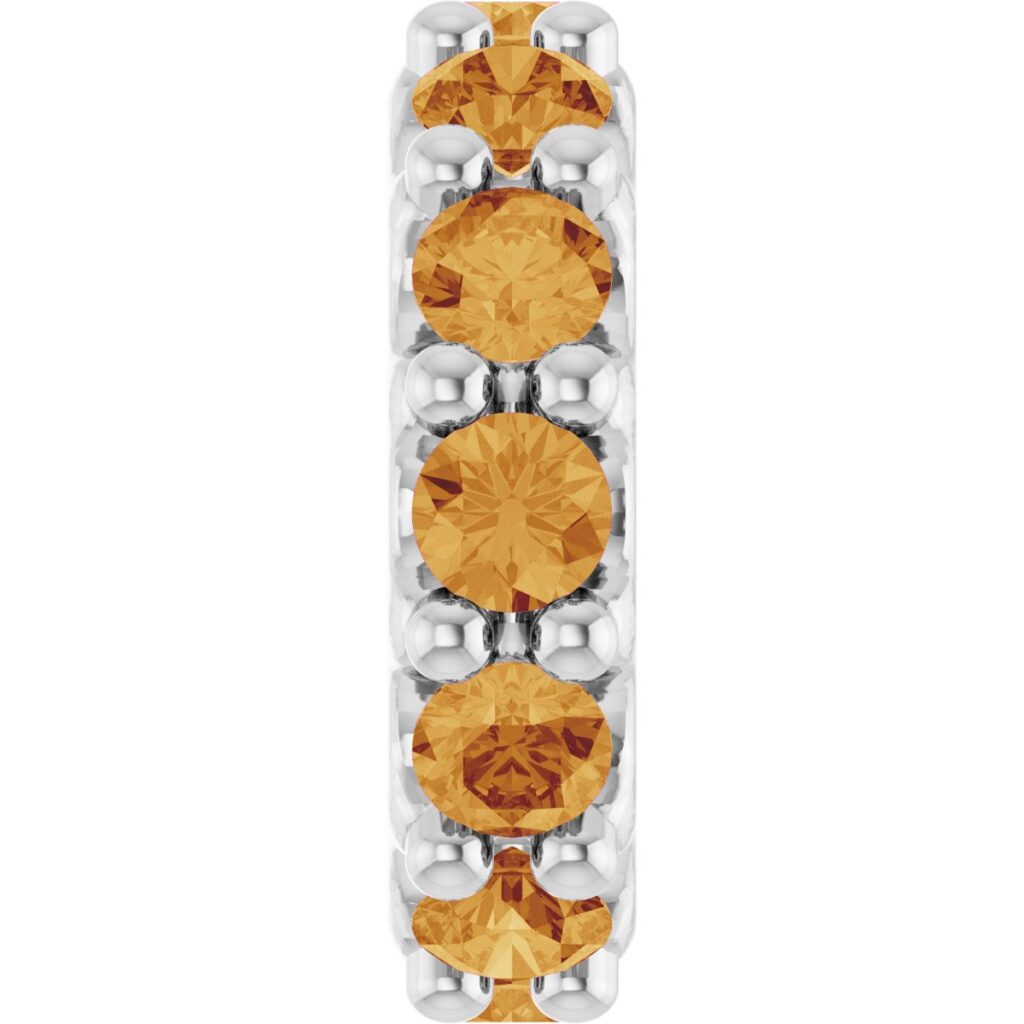
- A bolder band of color: the birthstone spacer, set with twelve 2 mm stones of one kind, or diamonds.
- A larger single stone: the 6×4 mm oval, or the 9×7 mm lab-grown blue sapphire for September.
- June birthdays: the cultured akoya pearl, or lab-grown alexandrite on the solitaire and spacer.
Our charms are sold on their own; the chain is not included. Each page lists the bail opening, so check it against your chain using our guide on how to choose a chain for a pendant.
At IMPERVORA
- Birthstone Spacer Charm/Pendant with 12 Gemstones or Diamonds: twelve 2 mm stones in 14K white gold, 14K yellow gold or sterling silver, with 17 stone options including 1/3 ctw natural or lab-grown diamonds; charm 10.7 x 10.7 mm.
- Bezel-Set Gemstone or Diamond Solitaire Charm/Pendant, 3 mm: one 3 mm stone from 14 options, from natural garnet to a 1/10 ct natural diamond; bail opening 5.7 x 2.6 mm.
- 14K Yellow Gold 6×4 mm Oval Gemstone Solitaire Charm/Pendant: lab-grown ruby, natural amethyst or natural citrine in a 4-prong setting.
- 14K Yellow Gold 9×7 mm Lab-Grown Blue Sapphire Bezel-Set Charm/Pendant: a single lab-grown sapphire in a bezel setting.
- 14K Gold Cultured White Akoya Pearl Solitaire Charm/Pendant, 6 mm: a 6 mm cultured akoya pearl in 14K yellow or white gold.
Also in the range: the 14K Yellow Gold Gemstone Cabochon Charm/Pendant (natural chrysoprase, white opal or stabilized turquoise), the 14K Yellow Gold Lab-Grown Ruby Solitaire Charm/Pendant, 4 mm, and the 14K Yellow Gold Natural Moss Agate Bezel-Set Cabochon Charm/Pendant. Only in-stock stone and metal combinations can be selected on each page.
Frequently asked questions
Is a lab-grown birthstone a real gemstone?
Yes. A lab-grown ruby, sapphire, emerald or alexandrite has the same chemistry as the natural stone; it was grown in a laboratory instead of the earth. It is not an imitation, and our pages always label it lab-grown.
Are heat-treated gemstones fake?
No. Heating is a common, generally permanent treatment applied to many natural gemstones to improve color or clarity. The stone is still natural; the treatment is simply disclosed on the product page.
Which birthstones hold up to everyday wear on a charm?
Diamond, ruby, sapphire and alexandrite are the hardest of the birthstones we offer. Opal, turquoise and pearl are softer and suit pieces worn with more care.
Does the charm come with a chain?
No. Our stone-set charms are sold on their own, and each page lists the bail opening so you can choose a chain that fits.
Next step
Browse all charms and open the stone disclosure on any page you are considering. If you want help choosing a stone for a birthday or matching a chain, contact our Concierge; we reply within one business day.
To compare stones on one page, see our birthstone and gemstone jewelry selection, or browse gold charms and pendants with notes on checking the bail and chain.
