Quick answer
Choose a chain that passes easily through your pendant’s bail opening, in the same metal and color as the pendant, at a length that lets the pendant sit where you want it on your neckline. For most pendants that means a fine, dense link such as cable, box, rope, rolo or wheat, at 18 inches as a starting point. Avoid herringbone and other flat, liquid-style chains for pendants: they are not built to carry weight at a single point.
Getting one of these wrong is what usually spoils a new pendant: a chain that will not pass through the bail, a clasp end that cannot be threaded, or a flat chain that kinks under the weight. This guide walks through each decision in order: the bail measurement, chain width, link style, length, the clasp, and matching metals. Every chain mentioned by name below is in stock at the time of writing, and the widths, lengths and clasps quoted come from each product’s own listing.
What is a bail opening, and why does it decide everything?
The bail is the loop at the top of a pendant that the chain runs through. Its inside opening is the hard limit on which chains will fit. If the chain cannot pass through it, nothing else matters.
Where a manufacturer supplies the figure, our pendant listings show it as Bail opening, usually as two numbers in millimetres, for example “2.2 x 1.8 mm” on the 14K Yellow Gold 1/2 ct. Lab-Grown Diamond Pendant, or “1.6 x 1.5 mm” on the 14K White Gold 1/3 ct. Lab-Grown Diamond Pendant. Some charms give a single figure, such as “1.4 mm” on the 14K Yellow Gold .03 ct. Natural Diamond Love Charm/Pendant. Read the smaller of the two numbers as your working limit, because the chain has to clear the opening in both directions.
If a pendant listing does not show a bail opening, ask before you order. Our Concierge can check the manufacturer’s specification for you.
How wide should the chain be compared with the bail?
Chain width on our listings is the manufacturer’s stated width in millimetres. As a practical rule, choose a chain that is noticeably narrower than the smaller bail dimension, not one that only just squeezes through. A little clearance lets the pendant hang straight, turn freely, and slide to the center of the chain on its own.
Two worked examples using real listings:
- A bail of 1.6 x 1.5 mm leaves room for the 0.55 mm box chain or the 1 mm flat cable chain. A 1.25 mm rope chain would be close to the limit, with little clearance.
- A bail of 5.15 x 2.4 mm, as on the 14K Yellow Gold .02 ct. Natural Diamond Evil Eye Charm/Pendant, takes any of the gold chains quoted in this guide.
Width also changes the look. Under about 2 mm, a chain reads as a carrier for the pendant rather than a statement on its own, which is usually what you want with a small diamond or gemstone pendant. A heavy chain can visually overpower a delicate pendant even when it fits the bail.
Which chain styles are best for pendants?
Link style affects strength, how the chain lies, and whether it twists or kinks under a pendant’s weight. The table below covers the styles most buyers ask about. The “In stock” column names the width and clasp from the current IMPERVORA listing; it is not a list of every option.
| Style | How it is built | For a pendant | In stock at IMPERVORA |
|---|---|---|---|
| Cable | Uniform oval or round links joined one to the next | Good all-round carrier; light and simple | 14K Gold 1 mm Flat Cable Chain (lobster clasp); platinum cable chains |
| Box | Square links that form a square cross-section | Good; dense and resists twisting | 14K Gold 0.55 mm Box Chain (spring ring); Platinum 0.5 mm Box Chain |
| Rope | Strands twisted together in a spiral | Good; strong and reflects light | 14K Gold 1.25 mm Rope Chain (lobster clasp) |
| Curb | Links twisted so they lie flat | Good for small pendants | 14K Gold 1 mm Curb Chain (spring ring) |
| Figaro | Curb-type links in a long-and-short pattern | Works; the pattern shows beside the pendant | 14K Gold 1.25 mm Figaro Chain (spring ring) |
| Rolo | Round links of equal size | Good; links are easy for a bail to sit on | 14K Gold 1.1 mm Rolo Chain (spring ring) |
| Singapore | Twisted curb-type links with a fluid, sparkling look | Works for light pendants | 14K Gold 1 mm Singapore Chain (spring ring) |
| Wheat | Interlocking oval links in a braided look | Good; firm and fairly kink-resistant | 14K Gold 1 mm Wheat Chain (lobster clasp) |
| Paperclip-style | Long, flat, elongated links | Works; the pendant may sit on a long link | 14K Gold 1.25 mm Paperclip-Style Chain (lobster clasp) |
| Herringbone | Flat rows of angled links that lie like fabric | Not recommended for pendants | 14K Yellow Gold 1.6 mm Herringbone Chain (lobster clasp), best worn on its own |
Why not herringbone or omega-style chains?
Herringbone and omega-style chains are built from flat, rigid segments that lie smoothly on the skin. That is their appeal, and also their weakness: a pendant concentrates weight on one short section, which can bend or crease it. A permanent kink in a herringbone chain generally cannot be repaired. Wear these chains on their own, and choose a round or square-section link for a pendant.
What length should a pendant chain be?
Length decides where the pendant falls. The positions below are typical for an average adult neck; on a larger neck every length sits a little higher, and on a smaller neck a little lower. The pendant’s own height adds to the drop, so a tall pendant hangs lower than a small one on the same chain.
| Chain length | Where it usually sits | Good for |
|---|---|---|
| 16 in | At or just below the base of the neck | Small pendants you want close and visible with open necklines |
| 18 in | Just below the collarbone | The most common pendant length; a safe default |
| 20 in | A little below the collarbone | Pendants worn with higher necklines, or a slightly longer drop |
| 22 in | Upper chest | Larger pendants, or layering beneath a shorter chain |
| 24 in | Mid chest | Over clothing, or as the longest layer |
Our 14K gold chains in this guide are listed in 16, 18, 20 and 24 inch lengths, and some styles stop at 20 inches; each listing shows only the lengths currently available. We do not currently list a 22 inch option on these chains. If you are between sizes, measure a necklace you already own from end to end, or ask our Concierge.
Does the clasp have to fit through the bail?
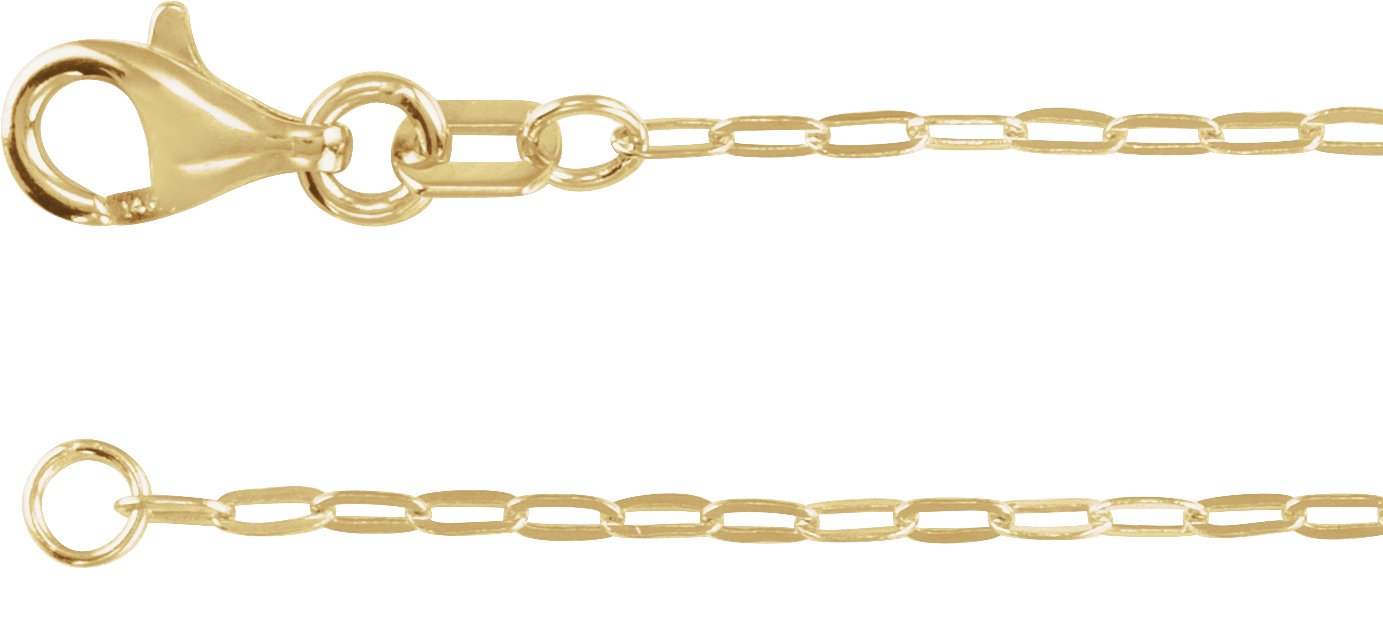
Often, yes. With a closed bail, you put the pendant on by opening the clasp and sliding the bail along the chain from one end. That means one end of the chain, either the clasp itself or the small ring it hooks into, must pass through the bail as well as the chain body. The ring end is usually the smaller of the two, so that is the end to thread first.
Our chain listings state the clasp type (lobster clasp or spring ring) but not the clasp’s dimensions. If your bail is small, ask our Concierge to confirm before you order rather than assuming. Pendants with an opening bail, such as a snap-on or hinged style, avoid this issue entirely; our guide to bails, clasps and connectors explains the differences.
Lobster clasp or spring ring?
Both are standard. A lobster clasp has a lever you press with a fingertip and is usually a little larger and easier to handle. A spring ring is a small round clasp with a sliding catch; it is compact, which can help with a tight bail, but takes more dexterity to open. The clasp type is listed on every chain in this guide.
How do I match the chain metal to the pendant?
- Match karat and color where you can. A 14K yellow gold pendant on a 14K yellow gold chain wears evenly and keeps the color consistent. Most of our gold chains are offered in 14K yellow and 14K white gold, and many also in 14K rose gold.
- White gold and platinum. White gold may be rhodium-plated where the listing says so, and that bright finish can look different from platinum’s natural gray-white color over time. Our platinum vs white gold guide covers this in more detail.
- Mixed metals are a style choice. There is no rule against a gold chain with a silver pendant, but softer metals wear at the point where they rub, so expect some wear where the bail sits.
- Check “solid” only where it is stated. Our platinum chain listings describe each chain as a solid platinum chain. Our 14K gold chain listings describe a 14K gold chain made to the stated width and do not state solid or hollow construction, so we do not describe them either way. Ask if construction matters to you. The Federal Trade Commission’s Jewelry Guides (16 CFR Part 23) set out how karat gold and terms such as “solid” should be used in jewelry descriptions.
At IMPERVORA
These in-stock chains are good starting points for a pendant. Widths, clasps and lengths are taken from each listing; available metal and length combinations change, so the product page always shows what can be ordered today.
- 14K Gold 1 mm Flat Cable Chain: 1 mm cable, lobster clasp, 14K yellow or white gold, 16, 18, 20 and 24 in.
- 14K Gold 0.55 mm Box Chain: the finest in this list at 0.55 mm, spring ring clasp, 14K yellow, white or rose gold, 16 to 24 in. A good match for small bails.
- 14K Gold 1.25 mm Rope Chain: 1.25 mm rope, lobster clasp, 14K yellow, white or rose gold, 16 to 24 in.
- 14K Gold 1.1 mm Rolo Chain: 1.1 mm rolo, spring ring clasp, 14K yellow, white or rose gold, 16 to 24 in.
For platinum pendants, see our platinum chains, described on each listing as solid platinum, in widths from 0.5 mm. You can browse every style in our chain collection, or read more about link styles on our gold chains page.
Frequently asked questions
Do IMPERVORA pendants come with a chain?
It depends on the piece. Many of our pendant and charm listings state “Chain: Not included”. Always check the product description, and never assume a chain is included.
What chain length is best for a pendant?
18 inches is the most common choice and sits just below the collarbone on most adults. Choose 16 inches for a closer fit or 20 to 24 inches for a lower drop or for layering.
How do I know if a chain fits my pendant’s bail?
Compare the chain’s width with the smaller of the two bail-opening figures on the pendant listing, and leave clearance. Remember that one end of the chain must also pass through a closed bail.
Can I wear a pendant on a herringbone chain?
We do not recommend it. Herringbone lies flat and can kink under a pendant’s weight, and a kink is generally permanent.
Are your 14K gold chains solid?
Our 14K gold chain listings do not state solid or hollow construction, so we do not describe them as either. Ask our Concierge if this matters for your choice.
Next step
Note your pendant’s bail opening, decide on the length, then compare widths in our chain collection. If you would like a second opinion on fit, send the pendant details to our Concierge; we reply within one business day.
Looking for the pendant first? Our gold charms and pendants page shows in-stock pieces and how to check the bail opening.
