Quick answer
A diamond grading report is a document from an independent gemological laboratory, such as GIA or IGI, that describes one specific diamond: its 4Cs, measurements, fluorescence, any laser inscription, whether it is natural or laboratory-grown, and any treatment the lab detected. It is a description of quality, not a statement of value, so it is not an appraisal.
At IMPERVORA, finished jewelry with set stones ships without an individual grading report unless the product page says otherwise. Instead, each listing states a supplier-assigned quality range for the stones. We do not currently sell loose diamonds.
What is a diamond grading report?
A grading report records what a laboratory observed when it examined a single stone. Widely known laboratories include the Gemological Institute of America (GIA), which developed the 4Cs grading system in wide use today, and the International Gemological Institute (IGI), which issues reports for both natural and laboratory-grown diamonds.
You will often hear these documents called “certificates”. The laboratories themselves generally use the word “report”, because the document describes the stone’s characteristics on the day it was examined rather than certifying or guaranteeing anything about it.
What does a grading report state?
Exact contents vary by laboratory and report type, but a full diamond grading report typically covers:
| Report field | What it tells you |
|---|---|
| Report number | A unique number you can check against the laboratory’s online records |
| Shape and cutting style | For example, round brilliant or oval |
| Measurements | Length, width and depth in millimetres |
| Carat weight | The stone’s weight, usually to two decimal places |
| Color grade | Position on the color scale; GIA’s scale runs from D (colorless) to Z |
| Clarity grade | From Flawless through Included (I1-I3), based on inclusions and blemishes at 10x magnification |
| Cut grade, polish and symmetry | How well the stone is proportioned and finished; a cut grade is usually given for round brilliants |
| Fluorescence | Whether the stone glows under ultraviolet light, and how strongly |
| Inscription | Any laser inscription on the girdle, often the report number |
| Origin | Whether the diamond is natural or laboratory-grown |
| Treatments | Any treatment detected, such as processes used to change color |
| Plot or diagram | On fuller reports, a map of the main inclusions |
Laboratories do not always describe lab-grown diamonds in exactly the same way as natural ones, and practices change. If a specific report matters to your purchase, check that laboratory’s own site for how its current reports are laid out.
What a grading report is not
- It is not an appraisal. A report does not state a price or replacement value. An appraisal is a separate document, prepared by an appraiser, usually for insurance.
- It is not a warranty. It describes the stone as examined; it does not promise anything about future condition.
- It does not cover the setting. A report grades a stone, not the metal, the craftsmanship or the other stones in a piece.
- It is not a substitute for an accurate product description. In the United States, the Federal Trade Commission’s Jewelry Guides (16 CFR Part 23) require that laboratory-created diamonds be clearly described as such, whether or not a report exists.
How do I check a grading report?
If you are buying a diamond that does come with a report, from any seller, a few checks take only minutes:
- Look up the report number on the issuing laboratory’s website. Both GIA and IGI offer online report checks, and the details shown should match the paper or digital report you were given.
- Match the measurements and weight. The millimetre measurements and carat weight on the report should match the stone you are buying.
- Check for an inscription. If the report lists a girdle inscription, a jeweler can confirm it with magnification.
- Read the origin and treatment lines. The report should say whether the stone is natural or laboratory-grown, and note any treatment the lab detected.
A report that cannot be found on the laboratory’s site, or whose details do not match the stone, is a reason to pause and ask questions before you buy.
Why don’t small set stones come with their own report?
Grading reports are issued stone by stone. For the small diamonds typical of pendants, charms and accent settings, an individual report for each stone is rarely practical, and a piece with many accents would need many reports. Instead, the industry commonly describes small set stones by a quality range, for example a color range and a clarity range that the stones fall within.
How does IMPERVORA describe diamond quality?
Our diamond jewelry listings state the quality of the set stones as a supplier-assigned range, and say plainly that no independent grading report is included. Here is the exact wording from three in-stock listings.
Lab-grown diamond pendants
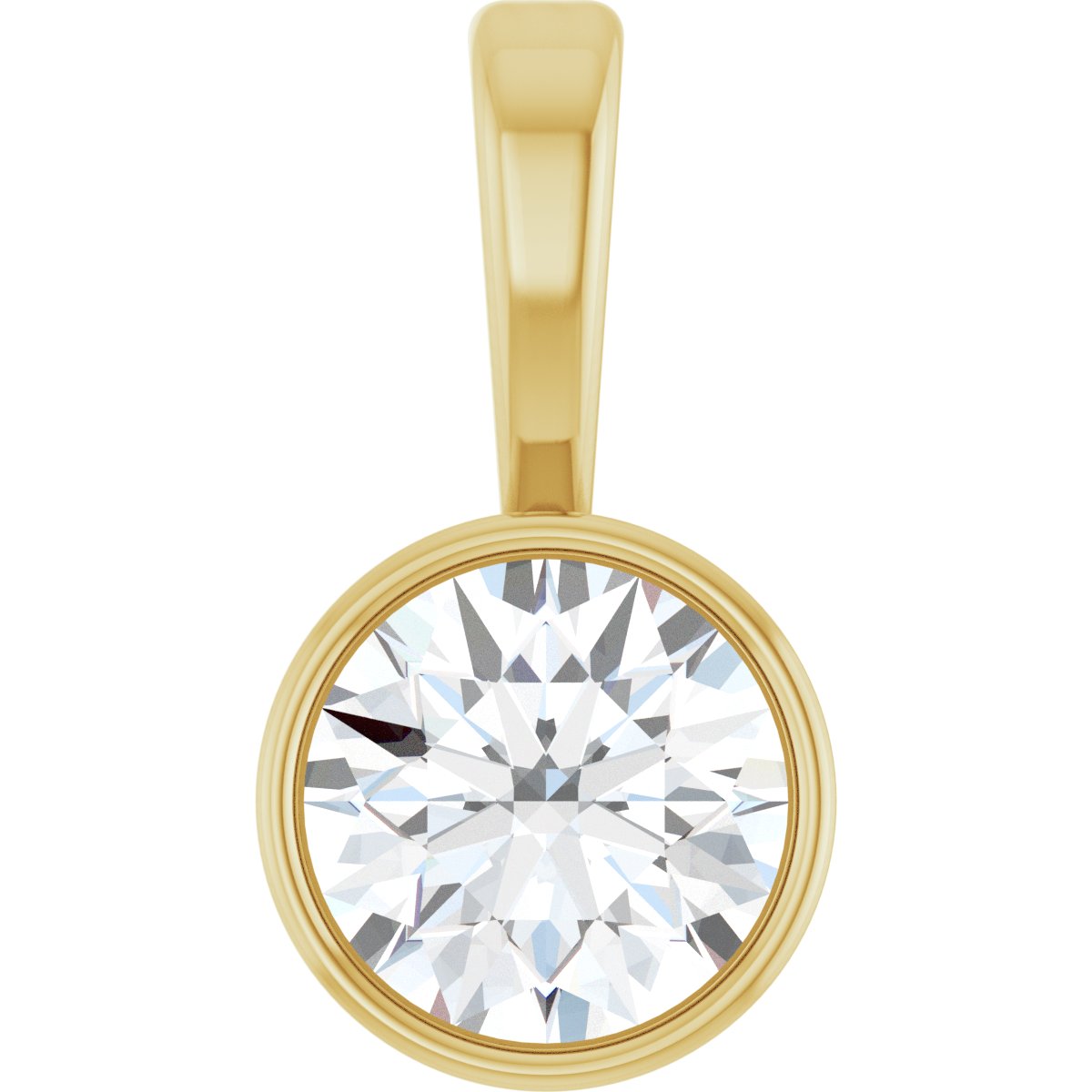
The 14K Yellow Gold 1/4 ct. Lab-Grown Diamond Bezel-Set Solitaire Pendant lists:
- Diamond quality: SI1-SI2, G-H (supplier-assigned range)
- Diamond disclosure: Lab-grown diamond, not a natural or simulated stone. Supplier-disclosed treatment: heating and pressure. Quality grades are the supplier’s assigned range; no independent grading report is included.
The 14K White Gold 1/3 ct. Lab-Grown Diamond Pendant uses the same format with a different range: “VS, F+ (supplier-assigned range)”.
Natural diamond charms
The 14K Yellow Gold .02 ct. Natural Diamond Evil Eye Charm/Pendant lists “Diamond quality: I1, G-H (supplier-assigned range)” and the disclosure “Natural diamond. Supplier disclosure: not treated. Quality grades are the supplier’s assigned range; no independent grading report is included.”
Our charm listings use a per-stone format. The 14K Yellow Gold 1/8 ctw Natural Diamond Horseshoe Charm/Pendant describes each group of stones separately, for example “2 × Natural Diamond, 1.2 mm (0.0075 ct each); clarity I1, colour G-H. Treatment: No treatment indicated”.
How to read a range
“G-H” means the stones fall within the G to H color grades; “SI1-SI2” means their clarity falls within Slightly Included 1 to Slightly Included 2. “F+” means F or better on the color scale. A range tells you the band the stones belong to, not the exact grade of any one stone. Our diamond buying guide explains what each grade means in practice.
When is a grading report included?
Only when the product page says so. If a listing names a grading laboratory or report, that statement is specific to that piece. Some of our lab-grown solitaire ring listings, for example, name IGI in their product details. If a report is important to your decision, ask our Concierge before you order to confirm the report details for that exact ring.
If a listing does not mention a report, assume none is included. Some listings say so directly; the Personalized Sterling Silver Dog Tag Charm with 1/6 ct Lab-Grown Diamonds, for instance, states “Not accompanied by a grading report.”
Should I get an appraisal for insurance?
If you plan to insure a piece, an independent appraisal is the document most insurers ask for. A qualified appraiser examines the finished piece and prepares a written valuation, usually stating a replacement value. Ask about the appraiser’s gemological training, what the fee covers, and what type of value the document will state. An appraisal is separate from a grading report, and a grading report is not required to obtain one.
At IMPERVORA
Every diamond listing tells you whether its stones are natural or lab-grown, the quality range, and the treatment disclosure. A few in-stock pieces that show the format clearly:
- 14K Yellow Gold 1/4 ct. Lab-Grown Diamond Bezel-Set Solitaire Pendant: SI1-SI2, G-H range; chain not included.
- 14K Yellow Gold .02 ct. Natural Diamond Evil Eye Charm/Pendant: I1, G-H range; not treated per the supplier disclosure.
- 14K Yellow Gold 1/8 ctw Natural Diamond Horseshoe Charm/Pendant: per-stone sizes and ranges listed.
Browse our lab-grown diamond jewelry and natural diamond jewelry. Not sure which you prefer? See our guide to natural vs lab-grown diamonds.
Frequently asked questions
Does IMPERVORA jewelry come with a diamond certificate?
Finished jewelry with set stones ships without an individual grading report unless the product page says otherwise. Each listing states a supplier-assigned quality range for the stones.
Is a grading report the same as an appraisal?
No. A grading report describes a stone’s quality characteristics. An appraisal is a separate valuation, usually prepared for insurance.
What does a quality range like G-H, SI1-SI2 mean?
The stones fall within the G to H color grades and the SI1 to SI2 clarity grades. It describes a band, not the exact grade of each stone.
Can I buy a loose diamond with a grading report from IMPERVORA?
Not at present. We do not currently sell loose stones.
Which laboratories issue grading reports?
GIA and IGI are two widely known laboratories. Each publishes information about its reports on its own website.
Next step
Read the quality range and diamond disclosure on any piece you are considering, then compare options in our lab-grown diamond collection. If you need report details for a specific piece, ask our Concierge before you order; we reply within one business day.
