Quick answer
Choose an engagement ring in this order: set the budget, pick the metal from what your partner already wears, choose the setting, and only then choose the stone, letting cut lead. Finally, get the size right and check the return terms before you order, because many set rings cannot easily be resized.
Most engagement ring advice starts with the diamond. That is the wrong end. The stone is the most expensive decision, so it should be the last one you make, after you know what your partner actually wears, what the ring has to survive, and what you are prepared to spend. Here is a sequence that works.
1. How much should you spend on an engagement ring?
Ignore the old rule about a number of months’ salary. It was popularized by advertising and has no basis in anything else. A budget is whatever you can spend without it becoming a problem, and that is a private number.
Deciding it first is what makes every later choice easy, because almost every subsequent decision is a trade-off within that number rather than an addition to it. If you would rather spread the cost, pay-over-time options such as Affirm, Klarna, Cash App Afterpay and Synchrony financing (subject to credit approval) are offered at checkout.
2. Which metal should the ring be?
What your partner already wears is the single most reliable signal available to you, and it costs nothing. Look at what is already on their hands and ears. Is it warm yellow, cool white, or pink? People are remarkably consistent about this, and a ring in the wrong metal is worn less regardless of what is set in it.
If everything is white, you are choosing between white gold and platinum; that comparison is here. If it is warm, yellow or rose gold. If it is genuinely mixed, a two-tone setting is a legitimate answer rather than a fudge.
Karat matters too, mostly for durability and color: 10K is 41.7% gold and 14K is 58.5%. See 10K vs 14K vs 18K gold compared.
3. Which setting style suits the way they live?
The setting decides how the ring looks and how it lives, and it constrains which stones make sense.
| Setting | What it looks like | Trade-off |
|---|---|---|
| Solitaire | One center stone on a plain band | Nothing competes with the stone, so its cut has to carry the ring |
| Halo | Center stone ringed by small diamonds | Center reads larger and brighter; more detail to clean and check |
| Three-stone | Center flanked by two smaller stones | Width on the finger without a much bigger center stone |
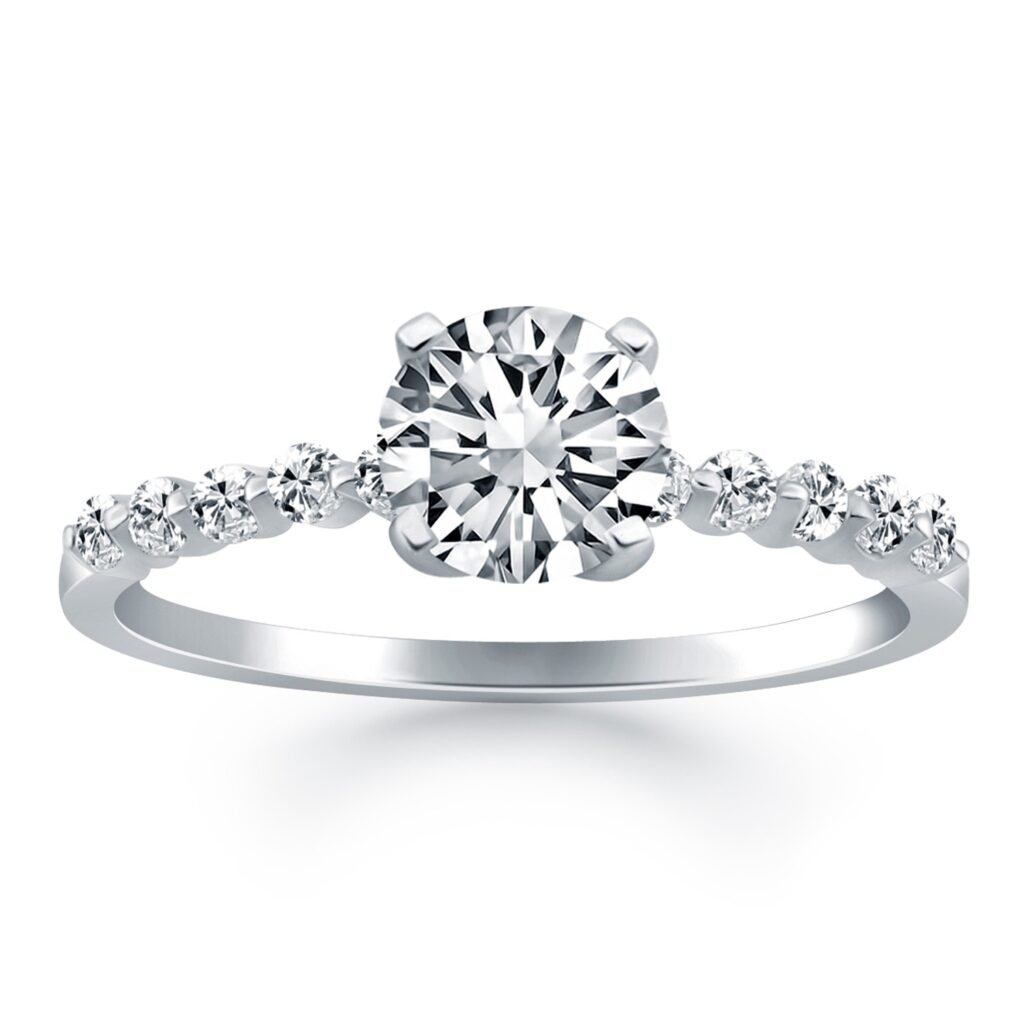
| Pave or accent band | Small diamonds set along the band | Extra sparkle; set bands are often harder to resize |
Also think about height. A high setting lifts the stone and catches more light; a lower one snags less on clothing and sits flatter beside a wedding band. If your partner works with their hands, lower is kinder.
4. How do you choose the diamond?
With metal, setting and budget fixed, the stone becomes a straightforward optimization. The four properties that drive price are cut, color, clarity and carat weight, explained in full in our guide to the 4Cs and in GIA’s overview of the 4Cs.
If you take one thing from that guide, take this: cut matters most. A well-cut stone with a slightly lower color grade will usually look better in ordinary light than a poorly cut stone with better paperwork.
You also choose between lab-grown and natural here. They are the same material, graded with the same vocabulary, and differ mainly in origin, price and resale; the comparison is here. At a fixed budget, lab-grown is typically priced lower for the same specification.
Shape is personal, but it has practical consequences. Round brilliants are the easiest to compare between sellers. Oval and emerald cuts can read larger for their carat weight because more of the stone sits face-up. Princess, cushion and radiant sit between the two.
Ask what documentation comes with the center stone. A grading report is issued for a specific stone; finished jewelry is often sold with a quality range instead. Either can be fine, provided it is stated in writing.
5. How do you get the ring size right?
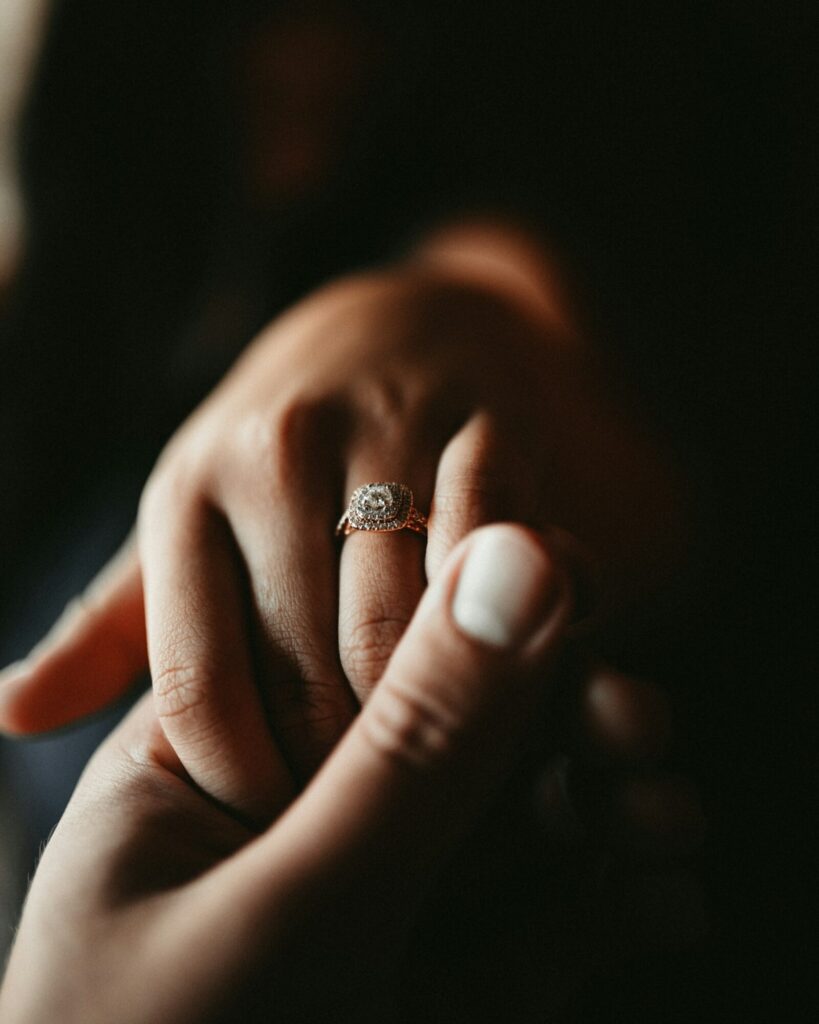
More proposals are undone by sizing than by taste. If you can measure a ring your partner already wears on that finger, do it; here is how. If you cannot, lean toward the larger of two sizes: a ring that will not pass the knuckle cannot be worn at all.
Do not assume a ring can be resized later. Eternity, channel-set and pave designs often cannot, and on any set ring it depends on the design. IMPERVORA does not list resizing as a service, so ask our Concierge about a specific design before ordering. If the size turns out wrong, an unworn ring can be returned within 30 days of delivery under our return policy; note that a piece resized or altered by a third party cannot be accepted back.
6. What should you check before you buy?
Before committing, confirm the return window, whether the specific design can be resized, and how the piece is shipped. In short: returns are accepted within 30 days of delivery for unworn pieces in original packaging, after requesting a return authorization by email; change-of-mind return shipping is paid by the customer. IMPERVORA ships to U.S. addresses only, with free shipping on orders of $75 or more, tracking on every order, and a signature that may be required on delivery. The full terms are in our return policy and shipping policy.
Engagement rings at IMPERVORA
Most IMPERVORA engagement rings are lab-grown diamond solitaires in 10K or 14K white or yellow gold, listed with an IGI laboratory certificate, G color and VS1 clarity for the center stone. Alongside them are 14K white gold designs with halos, accent stones and three-stone layouts. None of our ready-made engagement rings is platinum or 18K; those metals can be selected in our engagement ring designer, which sends the ring you configure to our concierge as a request, with availability varying by mounting. Examples:
- 1 Carat Round Lab Grown IGI G/VS1 Diamond Solitaire Ring in 10K White Gold: classic four-prong round solitaire on a 1.50 mm band, sizes 3 to 9.
- 1 Carat Oval Lab Grown IGI G/VS1 Diamond Solitaire Ring in 14K White Gold: the same specification with an oval center stone, which can read larger for its weight.
- 14k White Gold Solitaire Cathedral Engagement Ring: a six-prong cathedral solitaire on a 2.8 mm band; product details list a 0.50 carat minimum weight center diamond, I color, SI2 clarity.
- 14k White Gold Halo Antique Style Round Diamond Engagement Ring (5/8 cttw): a round center stone in a halo, with open flourishes along the shank.
- 14k White Gold 3 Stone Antique Design Diamond Engagement Ring (1 3/4 cttw): a princess-cut center flanked by two round diamonds, with band stones.
Frequently asked questions
Should I choose the diamond or the setting first?
The setting. It decides how the ring wears and which stones make sense, and it lets you spend the remaining budget on the stone with a clear brief.
Are lab-grown diamond engagement rings real diamonds?
Yes. Lab-grown diamonds have essentially the same chemical, physical and optical properties as natural diamonds. The difference is origin, which IMPERVORA states on each product page, and price.
Can IMPERVORA resize an engagement ring?
IMPERVORA does not list resizing as a service, and whether a ring can be resized depends on its design. Ask our Concierge before ordering, and measure carefully; an unworn ring can be returned within 30 days of delivery.
Do IMPERVORA engagement rings come with a grading certificate?
Only where the product page says so. Our lab-grown solitaires list an IGI laboratory certificate in their product details; other pieces describe stone quality in their details. Ask Concierge to confirm what accompanies a specific ring.
Next step
Browse all engagement rings, narrow to solitaires or lab-grown engagement rings, and look at wedding bands for the band that will sit alongside it. If you want help with size, documentation or a specific design, contact our Concierge; we reply within one business day.
Compare engagement rings, wedding bands and anniversary bands on our bridal and anniversary jewelry page.