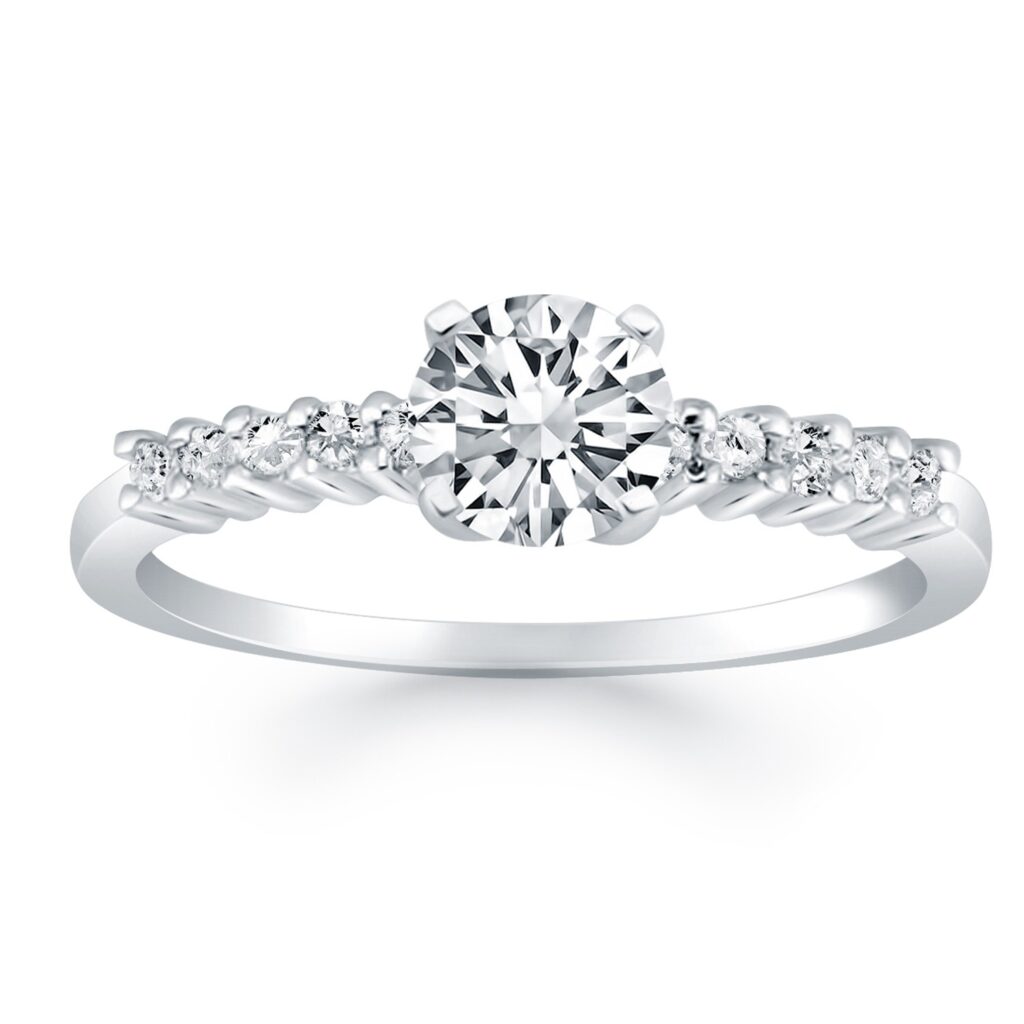
Short answer: a diamond’s shape is its outline, its cutting style is the pattern of its facets, and a cut grade is a separate judgment of quality that GIA gives only to standard round brilliants. Brilliant styles (round, oval, pear, marquise, heart, princess, radiant) favor sparkle; step cuts (emerald, Asscher) show color and inclusions more easily. Elongated brilliants can show a dark “bow tie”, and points and corners need protective settings. Weight doesn’t tell you face-up size; millimeter measurements and the length-to-width ratio do. In listing titles, “emerald” can name a shape or a gem, and “cut” can mean shape or grade, so read the whole title.
If you’re choosing a shape, or reading a title such as “Emerald Lab Grown Diamond Ring” and wondering what is in it, here is what each shape shows and what each word on a listing means.
Shape, cutting style and cut grade
GIA’s guide to reading its grading reports separates “The outline of the diamond (shape) and the pattern of the facet arrangement (cutting style).” “Oval brilliant” names both. The report’s cut grade is a different line, given “For standard, D-to-Z color, round brilliant diamonds.” GIA’s cut page says: “Diamond cut grades are only given to round brilliant cut diamonds”. Every other shape is a fancy shape.
Not every lab works this way. A 2024 study in GIA’s journal Gems & Gemology reports that “In the autumn of 2022, the International Gemological Institute (IGI) announced a cut grading service for nine fancy shapes”. So a cut grade on an oval or a pear may come from a different lab’s system than a cut grade on a round.
The insurer Jewelers Mutual notes that in product descriptions, shape and cut “are interchangeable when describing a gemstone’s general form” (Jewelers Mutual), so “princess cut” names a shape while “Excellent cut” names a grade.
Brilliant and step cuts: why sparkle differs
Jewelers Mutual describes two families. “Brilliant cuts have facets that are mostly triangular or kite shaped and radiate from the center.” Step cuts have “long, narrow facets in rows”, which it compares to a hall of mirrors (Jewelers Mutual).
GIA’s guide to diamond shapes says the round brilliant “is renowned for having the most brightness out of all the diamond cuts.” It calls the radiant “one of the most brilliant of the rectangular shapes”. Of the emerald cut, it says: “Its step cut facets highlight clarity and luster over brilliance.”
One wedding forum poster, after an emerald cut had been ordered, wrote: “I’ve been telling myself that I should’ve gotten an elongated radiant for the sparkle” (WeddingWire, 2022). Seeing both styles in person, or on video, before you choose may help.
Color and inclusions show more in step cuts
According to GIA, “the emerald cut tends to show inclusions and color more easily than other shapes”, and of Asscher cuts: “These diamonds tend to show inclusions and body color more readily than brilliant cuts”. An older GIA buying guide adds: “The emerald cut or a square step cut will require higher clarity since inclusions might be easier to see.” The radiant, by GIA’s account, “helps mask inclusions and warm colors”.
So a color and clarity grade that looks fine in a round brilliant may look different in an emerald or Asscher cut. If you prefer a step cut, study photos or video of the actual stone.
Apparent size: why the same weight can look different
Carat is weight, not face-up size. GIA says an oval “creates the illusion of a larger size per carat”. It also says the cushion’s “slightly deeper proportions can make them appear smaller than other shapes of the same carat weight”, and that a princess “may appear slightly smaller than other square-shaped diamonds”.
The reliable comparison is in millimeters. GIA reports list “length x width x depth” for fancy-shaped diamonds. Photos alone are hard to judge: one engaged poster comparing two oval sizes wrote that “the pictures from the seller make it hard to tell the scale.” Another poster suggested: “maybe cut a paper to those sizes and lay on your finger to see” (WeddingWire, 2018).
Length-to-width ratio
The length-to-width ratio is the length divided by the width. Near 1 means round or square; higher means longer and narrower. The 2024 GIA study reports that “Oval-shaped diamonds are commonly designed with L:W ranging from 1.2 to 1.7”, that “Pear shapes usually have L:W from 1.3 to 1.8”, and that “Marquise diamonds are typically longer with L:W from 1.5 to 2.5.”
There is no correct ratio. The same study found that “Observer choices for attractive L:W differ significantly from what is commercially available”, and that reporting the ratio and outline “may be more helpful for both the trade and consumer than setting strict grading limits”.
The bow tie in ovals, pears and marquises
A bow tie is a dark band across the middle of an elongated stone. The 2024 study explains: “The elongation inherent to oval, pear, and marquise shapes tends to produce a bow tie as part of the visual pattern for most choices of brilliant faceting arrangement and wide ranges of proportions”. It “can vary from slight to thick”, and “Some bow ties are persistent, while others brighten during motion of the diamond.” GIA’s older buying guide says hearts may show one too.
Whether it matters is partly taste. The study found that bow ties that are “particularly broad, dark, or persistent (as the stone moves) are generally disliked, but opinions diverge as this pattern becomes narrower, less intense, or changes from dark to light with motion.” Because GIA gives no cut grade to these shapes, a GIA report won’t settle it. A video of the stone moving shows more than a still photo.
Points and corners: chipping and protection
GIA says a marquise’s “length and pointed tips make it more susceptible to chipping”, and that a pear’s “pointed tip calls for extra care during setting and wear.” For the princess, GIA advises: “Round, claw or, ideally, V-shaped prongs should be used to protect the corners.” GIA says hearts typically perform best in settings “that offer protection to the point”, with prongs “set on the lobes (rather than in the cleft)”. Jewelers Mutual adds that “Vulnerable points or corners are better protected with bezels, partial bezels or V-shaped prongs” (Jewelers Mutual).
Trade accounts point to setting and repair work. On the Ganoksin jewelers’ forum, a member writing “As a Diamond cutter” said that “the ends breaking on Marquise diamonds was one of the most common reason for repair next to girdle chipping” (Ganoksin, 1999). Another member wrote: “On stones with points that are set in certain ways, sometimes the points will break from the pressure of the cooling metal” (Ganoksin, 2010). If a pointed stone needs prong work or re-tipping, ask the jeweler how the points will be protected. Our guide to bezel and prong settings compares the options, and our guide to wedding band gaps covers how elongated shapes sit next to a band.
How listing names can mislead
This section is general information, not legal advice. The FTC’s Jewelry Guides (16 CFR Part 23) use “emerald” both ways. §23.25 treats it as the name of a gem, alongside “ruby,” “sapphire,” and “topaz.” The note to §23.17 refers to “emerald-(rectangular) cut” diamonds. So in “Emerald Lab Grown Diamond Ring”, “emerald” may name the shape (a rectangular step-cut, lab-grown diamond) rather than a green emerald; the title alone doesn’t settle it. Read the noun at the end of the title, and the words before “diamond”; our guide to diamond and simulant labels explains them.
“Brilliant” has a specific meaning too. Under §23.17, the unqualified words “brilliant,” “brilliant cut” and “full cut” are reserved for “a round diamond” with set minimum facet counts. Its note allows the term for emerald-cut, pear, heart, oval and marquise diamonds that meet those counts “when, in immediate conjunction with the term used, the form of the diamond is disclosed”, as in “oval brilliant”. “Diamond-cut” on a chain is a finish, not a stone; see our guide to finish words.
If a listing gives a cut grade for a fancy shape, ask which lab or system assigned it. The Guides say that when a grade is claimed, “the identity of the grading system used should be disclosed” (§23.1, Note 1).
What to check on a listing
- Shape and cutting style, named separately (for example, oval brilliant or emerald step cut).
- Length and width in millimeters, and the length-to-width ratio.
- For ovals, pears, marquises and hearts: a video, to judge the bow tie as the stone moves.
- For step cuts: close photos or video of color and inclusions.
- For points and corners: how each one is held (V-prong, bezel or partial bezel).
- Any cut grade on a fancy shape: which lab, which system.
Next step
Our checklist for buying jewelry online covers what to save before you pay. If a listing doesn’t make the shape or its measurements clear, ask our Concierge (Concierge@impervora.com) before you order.