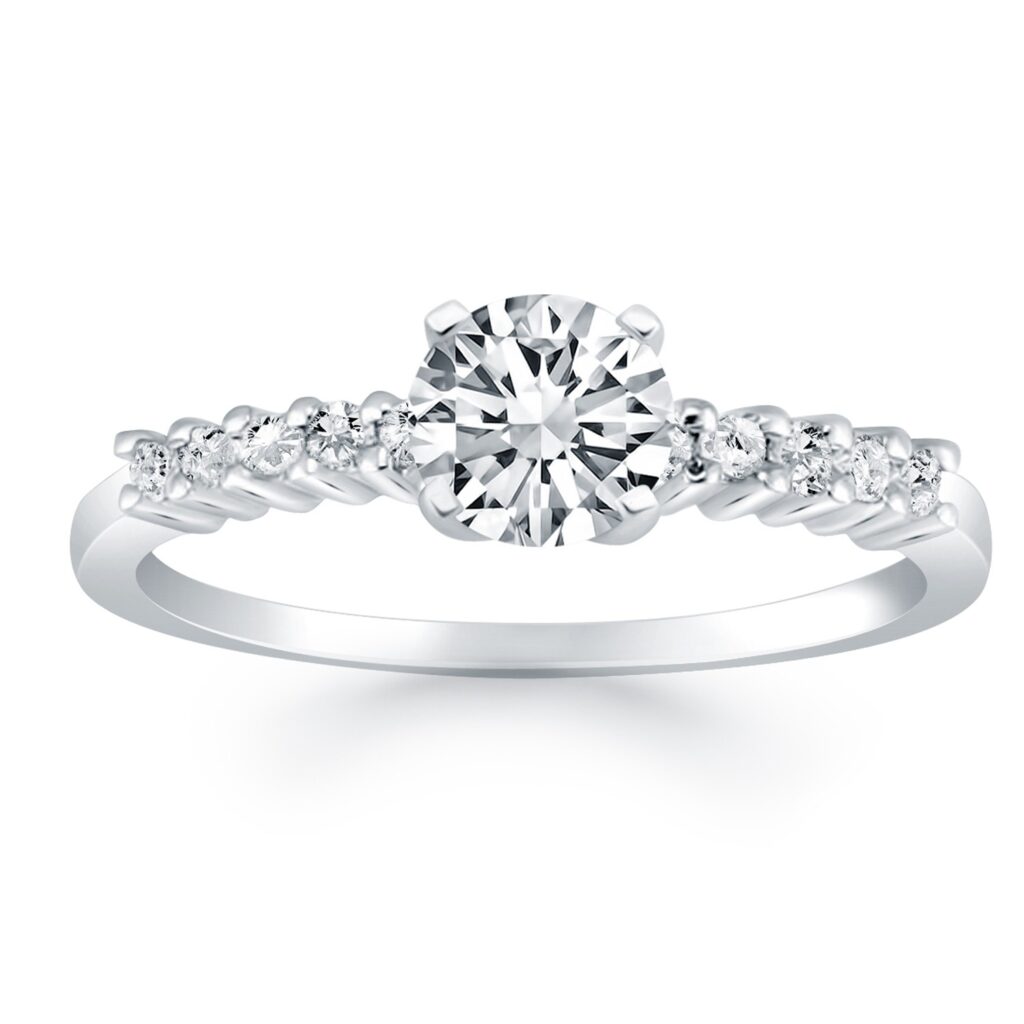
Short answer: fluorescence is the visible glow some diamonds give off under ultraviolet (UV) light. GIA, the Gemological Institute of America, describes its intensity on grading reports as None, Faint, Medium, Strong or Very Strong, and names the color when it is Medium or stronger. Blue is by far the most common color. Fluorescence is an identifying characteristic, not a quality grade. GIA says “25% to 35% of the diamonds submitted to GIA exhibit some fluorescence, but only 10% of those show enough fluorescence to impact appearance”. In GIA’s 1997 study, ordinary observers saw no systematic effect, and strongly blue stones were, on average, seen as having better color face-up. A hazy or oily look is rare. If fluorescence matters to you, look at the stone in more than one kind of light, including daylight, and ask the seller what its paperwork says.
If a report or listing says “Medium Blue” or “Strong” next to fluorescence and you’re wondering whether to worry, here is what that line means, what GIA’s research found, and the rare case where strong fluorescence does show.
What the fluorescence line on a report means
On a GIA report, fluorescence “refers to the strength, or intensity, of the diamond’s reaction to long-wave UV, which is an essential component of daylight”, according to GIA’s FAQ. GIA’s fluorescence myths article says its reports “describe the intensity of fluorescence as None, Faint, Medium, Strong and Very Strong. If the fluorescence is Medium, Strong or Very Strong, the color of the fluorescence will be noted on the grading report.” So “Medium Blue” means blue fluorescence of medium intensity.
GIA’s 1997 paper describes the lab’s procedure: a long-wave UV lamp in a darkened room, with the diamond placed table-down and compared against a set of reference diamonds. “None” doesn’t always mean zero. In GIA’s words, it “means that any fluorescence exhibited is weaker than that of the reference stone that marks the none/faint boundary.” Other organizations word the scale differently. The trade magazine Rapaport reported in 2020 that the American Gem Society and De Beers start their scales with “negligible” rather than GIA’s “none”.
Fluorescence isn’t one of the 4Cs. GIA treats it as “an identifying characteristic”, and its 1997 study called the report entry “a description, not a grade.” If you’re unsure what a grading report is, or how it differs from an appraisal, our guide to appraisals, insurance and paperwork sets out the three documents.
How common it is, and what color
GIA’s myths article says “The majority of diamonds do not fluoresce.” Its fluorescence page says “25% to 35% of the diamonds submitted to GIA exhibit some fluorescence, but only 10% of those show enough fluorescence to impact appearance”. It adds: “In more than 95% of the diamonds that exhibit fluorescence, the color seen is blue.” GIA lists other colors that occur, including yellow, orange, white and green.
In its 1997 study, GIA reviewed “a random sample of 26,010 GIA GTL grading reports” for colorless to faint yellow diamonds, and “approximately 65% of these diamonds had no reported fluorescence to long-wave UV radiation.”
Whether you notice it depends on the light. GIA says “You might see your diamond fluoresce under a bright sun, in a tanning bed, at a dance club or in other places where strong fluorescent or black lights are used”, and that “once the light source is removed, the diamond will stop fluorescing.” Incandescent lighting doesn’t make a diamond fluoresce, GIA adds.
What GIA’s 1997 study found
In 1997, GIA researchers Thomas Moses and colleagues noted “a perception in the trade that this fluorescence has a negative effect on the overall appearance of such a diamond” and set out to test it. Their paper in GIA’s journal Gems & Gemology, “A Contribution to Understanding the Effect of Blue Fluorescence on the Appearance of Diamonds”, reports a controlled study, and a small one: from more than 1,000 diamonds, the team chose 24 in four sets, each set closely matched except for fluorescence strength. Then 46 observers, from trained graders to people outside the trade, compared them in different positions and lighting. The findings:
- “For the average observer, meant to represent the jewelry buying public, no systematic effects of fluorescence were detected.”
- “Even the experienced observers did not consistently agree on the effects of fluorescence from one stone to the next.”
- In general, strongly blue diamonds “were perceived to have a better color appearance when viewed table-up, with no discernible trend table-down.” The effect was “most noticeable at lower color grades.”
- “Most observers saw no relationship between fluorescence and transparency.”
The authors concluded that “the diamond industry would be better served by considering each individual diamond on its own visual merits.” A 2017 GIA lab note summed up the study the same way: “blue fluorescence had little to no impact on color appearance or transparency except in extremely rare examples” of overblues.
Strong fluorescence and the hazy “overblue” look
Very few strongly fluorescent diamonds look hazy. The 1997 paper described “overblues” as diamonds with “extremely strong blue fluorescence and a distinctive oily or hazy appearance”, and said they are “even rarer than diamonds with yellow fluorescence”. The study didn’t include any: a true overblue “is not commonly encountered and was not part of our study.” GIA’s fluorescence page says: “A strongly fluorescing diamond that contains nano-inclusions may appear hazy or oily. Fewer than 0.2% of the fluorescent diamonds we see exhibit that appearance.”
A 2021 GIA study measured the effect with custom measurement and imaging systems. It found that the hazy look “is mainly attributed to light scattering from structural defects”, although “strong fluorescence causes minor contrast loss in the face-up patterns of some polished diamonds.” Its summary: “fluorescence alone does not noticeably reduce transparency.” The paper notes a belief, long discussed in the trade, that colorless D-to-F diamonds “are prone to appear hazy when combined with strong or very strong blue fluorescence”. Yet in its measurements it “saw no evidence that strong fluorescence alone produces noticeable haziness” in diamonds that didn’t already have those defects or nano-inclusions. In stones that do have them, the paper says fluorescence “may cause a diamond to appear even milkier or hazier.”
A report line of Strong or Very Strong describes how the diamond reacts under a UV lamp; it doesn’t say whether the stone looks hazy, which you judge by seeing it in ordinary light.
Does fluorescence change value?
GIA’s answer is that “Jewelry professionals disagree about whether fluorescence adds to or detracts from the value of a diamond.” According to GIA, some in the trade believe very rare top-color diamonds with extremely strong blue fluorescence are worth less because of a possible hazy look, while some pay more for blue-fluorescing diamonds of lower color because they believe the blue masks a faint yellow tint. The 2021 paper notes that “pricing adjustments based on fluorescence continue in the trade”. GIA’s advice: “We recommend that you compare diamonds in a variety of lighting environments and choose the stone that you like best.”
A glow doesn’t prove a diamond is real
A glow under a black light shows that a stone fluoresces and doesn’t show what the stone is. GIA says: “The presence or absence of fluorescence should not be used as a DIY test to determine if your diamond is real.” Our guide to what home tests and testers can’t prove explains why.
Lab-grown diamonds and fluorescence
Lab-grown diamonds can fluoresce too. GIA has written that in lab-grown (synthetic) diamonds, “Common fluorescence colors include green, yellow-green, yellow, orange and red”, that their fluorescence “is often stronger under short-wave than under long-wave ultraviolet light”, and that some “might glow for a minute or more after the ultraviolet lamp is turned off”, which is called phosphorescence. GIA also notes that “a particular synthetic diamond may not display any fluorescence”, and that between natural and lab-grown diamonds “there is overlap.” Telling them apart is a job for a laboratory, which uses instruments such as fluorescence imaging to see a diamond’s growth patterns.
What to ask before you buy
- What does the report say for fluorescence, both intensity and color? If there’s no report, how was fluorescence described, and by whom?
- Can I see the stone, or photos or video of it, in daylight as well as indoor light?
- Does it look hazy, milky or oily in any light? This matters most for Strong and Very Strong stones.
- What is the return policy if it looks different when it arrives? Our guide to buying jewelry online covers what to save and check before you pay.
- Keep the listing and any report with your receipt.
Treat the fluorescence line as information, not a verdict. In GIA’s words: “Fluorescence isn’t bad for a diamond, but it is important to know the fluorescence of your diamond before making your purchase.”
Next step
If a listing doesn’t say what you want to know about fluorescence, ask our Concierge (Concierge@impervora.com) before you order.