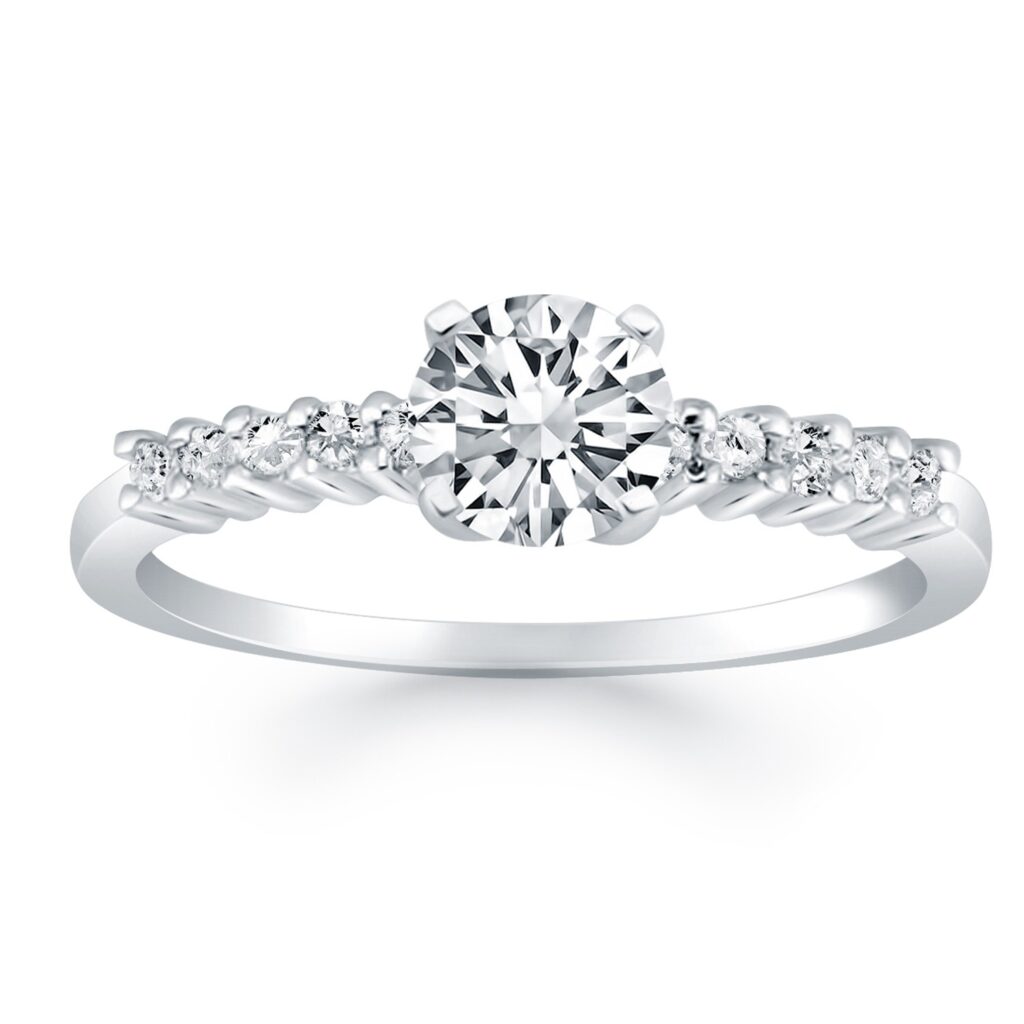
Short answer: “ct. tw.” stands for carat total weight. It is the combined weight of every diamond in a piece of jewelry, added together. It does not tell you how big the largest stone is. A ring marked “1 ct. tw.” might hold a single one-carat diamond, or a smaller center stone surrounded by dozens of tiny ones that together reach one carat. Before you compare prices, find out how that total is split up.
What ct. tw. means, and the other abbreviations you will see
Sellers write the same idea several ways. All of the following mean the total weight of the diamonds in the piece:
- ct. tw. or tw: carat total weight
- ctw: carat total weight
- cttw: another spelling of carat total weight
- tcw: total carat weight
Plain ct on its own usually describes a single stone, such as “0.50 ct round diamond.” If a listing says “ct” but the piece clearly has more than one diamond, ask which stones the number covers.
You may also see total gem weight. GIA uses this term for a ring set with different types of stones, such as a center diamond with ruby, sapphire or emerald side stones, so it is a different number again.
GIA describes total carat weight as the weight “of all the diamonds in a multi-stone ring.” It is a sum, not a size.
A worked example: same total, very different rings
The table below uses invented, round numbers to show the idea. These are illustrations only, not IMPERVORA products or prices.
| Example (hypothetical) | Center stone | Side or accent stones | Total shown on the tag |
|---|---|---|---|
| Example A: solitaire | 1.00 ct | None | 1 ct. tw. |
| Example B: three-stone | 0.50 ct | 2 × 0.25 ct | 1 ct. tw. |
| Example C: halo | 0.50 ct | 25 × 0.02 ct = 0.50 ct | 1 ct. tw. |
| Example D: pavé band | None | 50 × 0.02 ct = 1.00 ct | 1 ct. tw. |
All four would carry the same “1 ct. tw.” label. On your hand they look nothing alike. In Example C, half of the stated weight sits in tiny stones you will see as sparkle, not as size. In Example D there is no main stone at all.
Why the center stone matters more than the total
Diamond prices do not rise in a straight line with weight. Larger diamonds are rarer than small ones, so a single larger stone usually costs more per carat than several small stones of the same combined weight. GIA notes that diamonds at or just above “magic sizes” such as 0.50 ct and 1.00 ct are generally more expensive per carat than stones slightly below them.
That has two consequences for you:
- Two pieces with the same ct. tw. can be fairly priced very differently. A one-carat solitaire and a one-carat-total pavé band are different products. Comparing them by total weight alone will mislead you.
- A large total does not mean a large center stone. If what you care about is how big the main diamond looks, the total weight is the wrong number to judge by. Ask for the center-stone weight on its own.
Weight is not the whole story for appearance either. GIA notes that the way a stone is cut “also affects its perceived size,” so two stones of similar weight can look different in size.
To find the center stone on a listing, look for a separate line such as “center: 0.50 ct” or a stone breakdown (“1 × 0.50 ct, 24 × 0.02 ct”). If the listing gives only a total, the breakdown is a reasonable thing to ask for.
Carats, points and grams
The units are fixed by definition:
- 1 carat = 0.2 gram (200 milligrams, or 1/5 gram).
- 1 carat = 100 points. A “25-point” diamond weighs 0.25 ct.
The FTC’s jewelry guides say that if a seller describes weight in points, the weight should also be given in decimal carats, for example “25 points or .25 carat.”
Fractions vs decimals: how exact is “1/2 ct. tw.”?
The FTC’s Guides for the Jewelry, Precious Metals, and Pewter Industries cover diamond weight in 16 CFR §23.18, “Misrepresentation of weight and ‘total weight.'” They treat the two common styles differently:
- Decimal weights (such as “.47 carat”) “should be accurate to the last decimal place.” When only one decimal place is shown, the figure should be accurate to the second; the rule’s own example is that “.5 carat” could represent a diamond weight between .495 and .504.
- Fractional weights (such as “1/2 ct. tw.”) are not exact. §23.18(d) reads in full: “If diamond weight is stated as fractional parts of a carat, a conspicuous disclosure of the fact that the diamond weight is not exact should be made in close proximity to the fractional representation and a disclosure of a reasonable range of weight for each fraction (or the weight tolerance being used) should also be made.”
That is the text on eCFR as of October 19, 2026; it has read this way since the FTC’s 2018 revision of the Guides. A note to paragraph (d) adds that in catalogs and other printed materials the disclosure should appear on every page that shows a fraction, and that it may point to a chart of the ranges used. The FTC’s example wording: “Diamond weights are not exact; see chart on p. X for ranges.”
So “1/2 ct. tw.” is a label for a range, not a measurement. Even the FTC’s own examples differ: its business guidance for advertisers says a diamond described as 1/2 carat “could weigh between .45 and .54 carat,” while its consumer advice page gives “.47 and .54 carat” for the same fraction. The range that counts is the one the seller states for the piece in front of you.
The FTC’s consumer advice puts it plainly: if a seller gives a diamond’s weight in fractions, “they should tell you the weight is not exact, and tell you the reasonable weight range for the diamond.” If you see a fraction with no nearby note that the weight is not exact, and no range, ask for both before you buy.
Total weight and grading reports
A standard diamond grading report describes one individual stone. Some laboratories also issue reports for finished jewelry. GIA, for example, describes its jewelry reports as giving “estimated total carat weight, color and clarity ranges,” and notes: “Grading is performed to the extent that the mounting permits.” The small accent stones that make up much of a total weight are often not individually graded; their quality is commonly described as a range. Total weight also says nothing about color, clarity or cut. Those are graded separately from weight.
Questions to ask any seller before you buy
Whoever you buy from, these questions turn a total-weight label into information you can compare:
- What does the center stone weigh on its own? Ask for the decimal weight, not a fraction.
- How many diamonds are in the piece, and what does each group weigh? For example, “1 center at 0.50 ct, 24 accents at about 0.02 ct each.”
- Is the total exact or rounded? If the listing uses a fraction, what range or tolerance does that fraction cover?
- Is there an exact decimal total weight? Some sellers can give one even when the tag shows a fraction.
- Are the diamonds natural or lab-grown? Both are weighed in carats, but they are separate products and are priced separately. See our guide to lab-grown, simulant and natural diamond labels.
- Is the center stone covered by a grading report, or are the grades a supplier-assigned range? The answer affects how you compare one piece with another.
- What is the return policy? Seeing a piece in person is the surest way to judge whether it looks the way you expected.
A quick way to read a tag
When you see a weight on a listing, run through three checks:
- Is it “ct” or “ct. tw.”? One stone, or the sum of all of them.
- Is it a decimal or a fraction? Decimals should be accurate to the last digit shown; fractions are not exact and should come with a stated range.
- Is the center stone listed separately? If not, ask for it before you compare prices.
Sources
- U.S. Federal Trade Commission, Guides for the Jewelry, Precious Metals, and Pewter Industries, 16 CFR §23.18 (eCFR, text current as of October 19, 2026).
- FTC, “In the Loupe: Advertising Diamond, Gemstones and Pearls”, business guidance, July 2019.
- FTC Consumer Advice, “Buying Gemstones, Diamonds, and Pearls”, November 2024.
- FTC, revised Jewelry Guides, 83 FR 40665, August 16, 2018. Older articles cite this rule as §23.17; it moved to §23.18 in this revision.
- GIA, “Nine Things About Diamond Carat Weight You Need to Know”, May 17, 2018.
- GIA, “Jewelry Reports & Services Details”.
Have a question about a specific piece?
Some IMPERVORA listings state diamond weight as a fraction. Those weights are not exact, and we can give a weight range only where our supplier provides one, so ask before you buy. If you want to know how the diamond weight of a piece breaks down, email our Concierge at Concierge@impervora.com or use our contact page. Tell us which piece you are considering and we will tell you what information we have for it. For more background, read our guides to diamond treatments and telling whether a diamond is real. Our return and refund policy sets out how returns work.