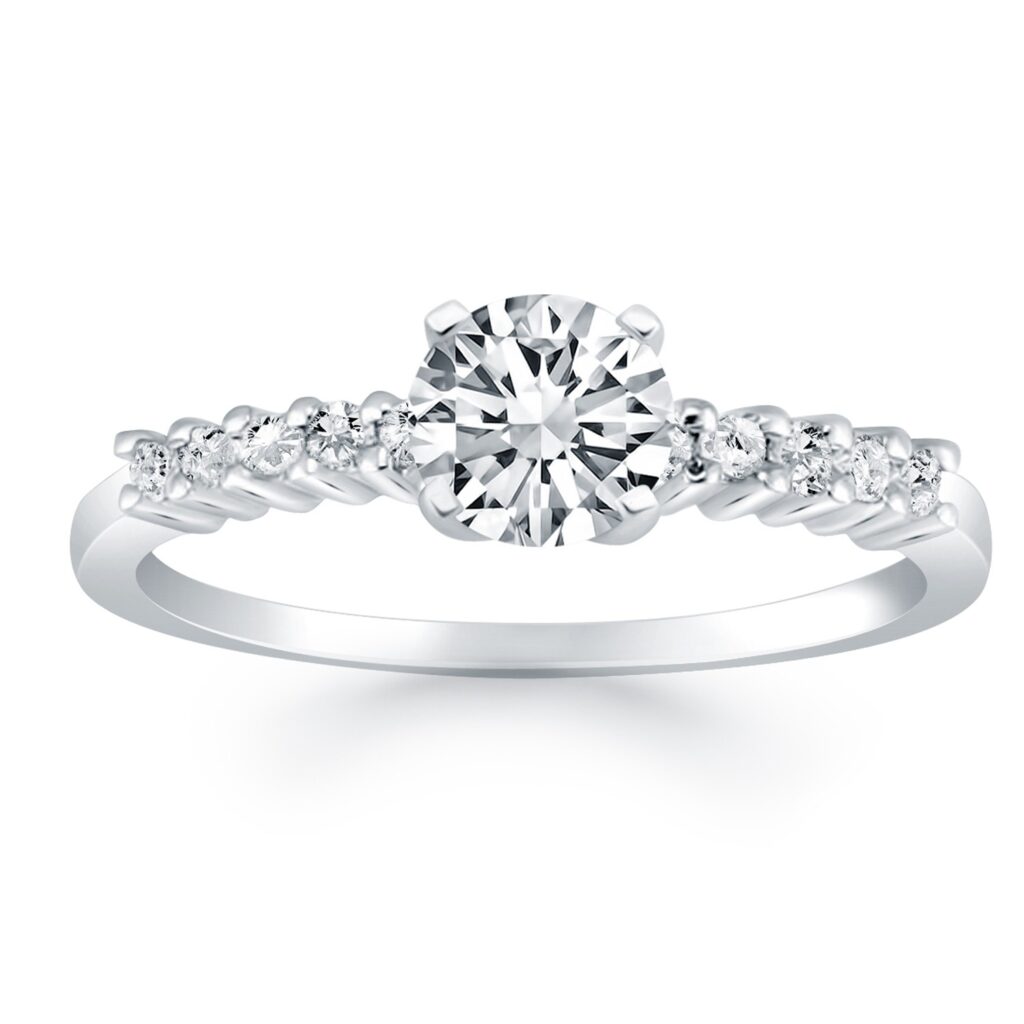
Short answer: Yes, fine scratches on a new ring or band are normal. Gold, platinum and silver are all softer than diamond, so even the stone in an engagement ring can mark them. The metals wear in different ways: the higher the karat, the more readily gold marks, sterling silver is softer still, and platinum’s marks build into a soft matte surface called a patina. A jeweler’s polish removes scratches by abrading the surface, so it takes off some metal each time; on platinum, a jeweler may burnish instead, pressing the surface smooth. None of the sources below sets a polishing schedule, so polish when the look bothers you, and ask first if the band is thin, engraved or textured, or if the problem is a dent.
Why a new ring scratches so quickly
Precious metals are softer than diamond. GIA’s care guide points out that “diamond can also scratch any of the precious metals used for settings” (GIA, Diamond Care and Cleaning Guide). Jewelers Mutual, a jewelry insurer, says that “One of the most common ways jewelry is damaged is being scratched by other jewelry” (Jewelers Mutual, engagement ring care).
A band that shows hairlines after a few weeks is most likely showing ordinary wear. If you wear two rings together, our guide on whether the two rings will wear against each other covers the contact points to check.
Gold, platinum and silver wear differently
Gold
Pure gold is soft, and alloying hardens it. In GIA’s words, “Higher karat gold, such as 24k, is the purest and softest, making it more prone to scratches and dents.” (GIA 4Cs, The Best Ring Material For Everyday Wear, 2025). For the 14K versus 18K question, see 10K vs 14K vs 18K gold. Rose gold can also darken at the surface over time; our rose gold guide explains why.
Platinum
Platinum scratches too, but it tends to look different as it wears. Platinum Guild International, the platinum industry’s promotional body, describes it like this, as quoted in the trade magazine JCK: “When platinum is scratched, metal is displaced, rather than flaked and lost, as with other metals.” (JCK, 2024). The same GIA guide says that “Over time, platinum develops a patina that gives it a unique, antique look.” and that it “can be polished away if you prefer a shinier appearance”. On the Ganoksin jewelers’ forum, a forum member explained the mechanism: “The patina that develops on platinum is merely the loss of polish through the normal abrasions of everyday wear.” (Ganoksin, 2017).
How much metal each loses has been tested, but by an interested party. A study commissioned by Platinum Guild International, comparing platinum with white gold alloys, found that in abrasion tests “gold lost metal weight, while platinum did not”. A World Gold Council consultant agreed that platinum tends to wear better than white gold but said both perform well, citing “the minuscule losses recorded during the lengthy testing cycles employed” (JCK, 2021).
Silver
GIA’s description of sterling: “Silver is soft, can scratch, and takes on an aged appearance.” (GIA 4Cs, Choosing Between White Gold, Platinum, Palladium, and Silver, 2015).
White gold and rhodium plating
Most white gold you see has a second surface. According to GIA, “white gold is usually plated with rhodium for a whiter look, a better shine and to protect against scratching.” (GIA 4Cs, 2018). GIA’s 2015 white-metal guide adds that “Rhodium plating will wear away gradually over time, requiring the ring to be replated occasionally.”
On a plated ring, then, what you see wearing may be the plating rather than the metal under it. GIA’s 2025 guide says that “as the rhodium plating wears away, the ring may start to appear warm in color.” If a plated ring is polished, ask whether re-plating is part of the job. The same plating on silver is covered in our guide to rhodium-plated sterling silver.
How the finish changes what you see
The same scratch reads differently on different surfaces. One wedding band maker’s guide says that “Brushed rings tend to hide small scratches better, especially if the new marks follow the existing grain.” and that “If the scratches cut across that pattern, they may stand out more.” (one maker’s finish guide, 2026). The same guide notes that restoring brushed and matte finishes evenly “takes texture work, not just simple buffing”. It also says “Polished rings usually show fine scratches the most.” Our guide to finish words collects bench jewelers’ views, including one who held that a polished surface is the easiest to restore and textured finishes the hardest.
What a jeweler’s polish actually does
Abrasive polishing removes a scratch by bringing the surrounding surface down to the bottom of it. GIA’s bench standards for refinishing worn platinum say: “Alternatives to burnishing a platinum ring prior to finishing include filing, heavy polishing, and using abrasive wheels. Since these reduce structural integrity, burnishing is the preferred method.” Burnishing presses the metal smooth with a hard, polished tool, and GIA says “Burnishing the scratches maintains the integrity of the metal weight and shape” (GIA Quality Assurance Benchmarks, burnished platinum). In a Ganoksin thread about restoring silver rings, a forum member explained that “These deeper scratches once repaired often require a lowering of the whole surface area to feather in the footprint.” (Ganoksin, 2021).
How often is sensible? None of the sources we checked gives a standard interval for polishing. GIA’s consumer guide says “gold rings benefit from regular polishing to keep their shine”, while its bench pages show why each abrasive pass has a cost. Jewelers Mutual recommends having platinum jewelry “professionally cleaned and inspected twice a year”; an inspection is not the same as a polish. A practical middle course is to have the ring checked regularly and polished when the look matters to you, and to ask what method the jeweler will use.
Engraving, thin bands and prongs
On engraving, in a bench article on Ganoksin, Mark Mann describes refinishing a hand-engraved ring with “surface abrasions and percussion marks (normal wear)” and warns that “Re-finishing with standard abrasives and then polishing could wear away too much of the surface and the detail of the engraving.” (Ganoksin, Mark Mann).
On thin bands, GIA’s example of a worn platinum ring that a customer asked to have polished concludes: “This ring is not a candidate for refinishing”, noting that “The shank is thin and appears to have a pitted and cracked solder joint” (GIA Quality Assurance Benchmarks, refinishing worn platinum). On the burnished ring described above, GIA notes that “Filing instead of burnishing to remove scratches in the platinum shank would have caused it to become very thin”.
For prongs, one of GIA’s checks after refinishing is that “Prong shape, dimensions, and structural integrity have been maintained”. GIA also advises that “prongs can be damaged or loosen, so they should be checked periodically and repaired or tightened if needed”.
Dents and hollow pieces
A dent, a flat spot or a band pushed out of round changes the ring’s shape, so it is a repair question for a jeweler, separate from polishing out surface scratches. Hollow pieces are the hardest case. In a Ganoksin thread about a dented hollow bangle, one forum member wrote that “Hollow tubular bracelets are notoriously difficult to repair.” and advised telling the customer that “the repair will likely cost much more than the bracelet did” (Ganoksin, 2022). Our guide to solid, semi-solid and hollow gold explains why thin walls generally dent more easily.
What you can do at home, and what to skip
- Clean before you judge. Jewelers Mutual notes that platinum “can still accumulate dirt, oils and grime, which can make it appear dull” (Jewelers Mutual, platinum care).
- Skip toothpaste and baking soda. Jewelers Mutual warns that “Toothpaste has abrasives that can scratch gold and some gemstones” (Jewelers Mutual, cleaning gold) and that “abrasives like toothpaste and baking soda can scratch softer stones and metals”.
- Be wary of home scratch removers. We did not find authoritative testing of branded scratch-removal products, so we can’t speak to any of them. The sources above point one way: abrasives take metal off, and Jewelers Mutual warns on white gold not to “scrub too hard, as this can damage the rhodium plating” (Jewelers Mutual, cleaning white gold). Leave sanding and buffing to a jeweler.
- Store pieces apart. Jewelers Mutual advises: “To prevent scratching, keep platinum pieces away from other metals and delicate gemstones.”
Questions to ask before a polish or refinish
- Will you burnish, polish or both, and is the band thick enough for it?
- Will the engraving still be legible, and will you check the prongs first?
- For a plated ring, is re-plating included?
- For a brushed, satin or hammered finish, can you match the texture?
If you’d like to know a ring’s metal, karat or finish before you order, ask our Concierge (Concierge@impervora.com).